Collaborative African lion research programme

Collaborative Comparative Lion Research

A jointly led programme across contrasting African lion populations.

We investigate how ecological conditions shape lion social behaviour, collective action, communication, and perception by comparing populations that experience very different ecological and social environments.

Programme co-PIs

Natalia Borrego & Genevieve E. Finerty

Programme co-leads during lion research

Funding & programme development

One programme built through three linked awards.

Each award expanded the same collaborative programme: first establishing a comparative framework for lion sociality, then adding whole-group approaches to collective action, and finally extending the programme toward the sensory information available before animals act.

2021 · Collaborative Research Grant

When does lion sociality emerge—and when does it break down?

MPI-AB / University of Konstanz

Established the multi-population comparative foundation linking ecological variation to social structure, cooperation, and movement.

Added: comparative field systems and a framework for asking when different social strategies become more or less advantageous.

Official award announcement →

2022 · CASCB Newcomer Project

Cooperation in collective action: on the “hunt” for role specialisation.

Centre for the Advanced Study of Collective Behaviour

Extended the programme from the ecology of sociality to the organization of collective action among known individuals.

Added: whole-group multi-sensor biologging and fine-scale measurement of collective movement, communication, and cooperative hunting.

Official CASCB project page →

2025 · ZENiT Fellowship

What do animals perceive?

Zukunftskolleg, University of Konstanz

Extends the programme from observed collective behaviour to the perceptual environment that precedes communication and coordination.

Added: sensory experiments, AI-supported multi-sensor analysis, and a mechanistic layer linking information, perception, and social decisions.

Official ZENiT award page →
People & collaborations

A jointly led programme built through long-term partnerships.

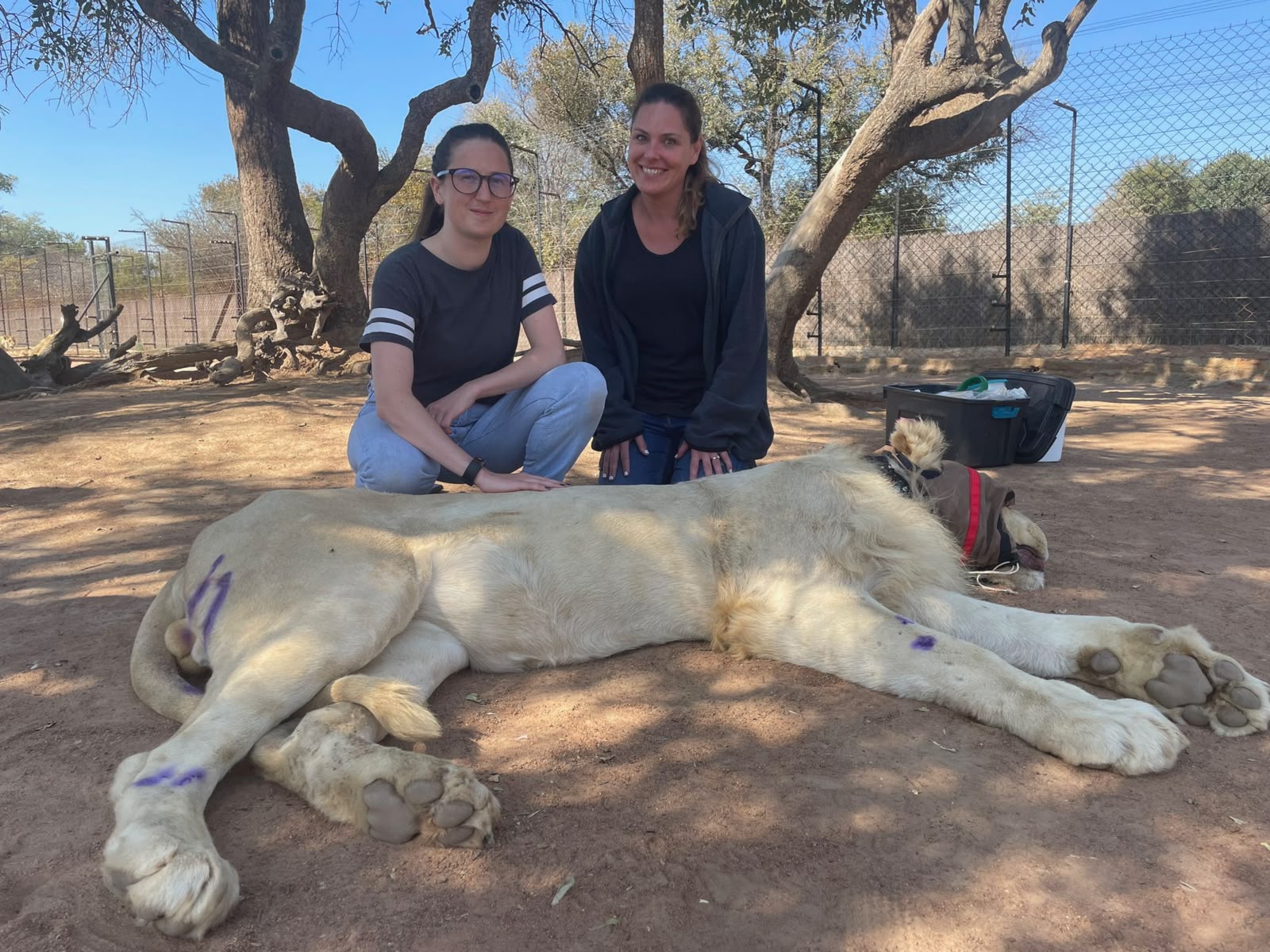
The programme is jointly led by Natalia Borrego and Genevieve E. Finerty. Specific grants bring additional scientific collaborators into the programme, while long-term field partnerships make the comparative research possible.

Co-Principal Investigator

Genevieve E. Finerty

Ecologist working at the interface of spatial and behavioural ecology, with interests in animal movement, social and spatial structure, and collaborative quantitative research.

Grant collaborators

Matthew Wijers University of Oxford ZENiT
Simon Chamaillé-Jammes CNRS ZENiT
Paul-Antoine Libourel Lyon Neuroscience Research Center ZENiT

Field partnerships

Ombonde Research Team · Namibia Long-term monitoring, field operations, and whole-group biologging.
Lion Rangers · Namibia Long-term field knowledge, monitoring, ranger collaboration, and capacity building.
Leopard Ecology & Conservation · Botswana Long-term Kalahari collaboration in lion ecology, tracking, and behavioural reconstruction.
San tracking team · Botswana Tracking expertise used to reconstruct hunts, movements, and behavioural events.
CyberTracker Tracking methodology, professional certification support, and field-team training.
Research partner · Zimbabwe Long-term conservancy collaboration supporting whole-pride biologging and behavioural monitoring.

Comparative design

Ecological variation is built into the programme.

The programme uses ecological variation across populations as a natural comparative framework for asking how lion social behaviour changes when the opportunities, costs, and constraints of social living differ. The populations retain the same basic social architecture while varying strongly in resource availability, population density, landscape structure, and human overlap.

Ecological axis
Namibia
Botswana
Zimbabwe
Resource availability
Low
Low
High
Lion density
Low
Low
High
Human overlap
Throughout the landscape
Strong at the human-use boundary
Low immediate overlap for the study population
Landscape context
Mountainous · semi-arid
Flat · semi-arid · pan system
Resource-rich · productive

The comparison is not intended to reduce each population to a single category. Instead, these broad ecological contrasts provide a common framework for asking which features of lion social behaviour remain stable and which change with context.

Shared research infrastructure

Following entire prides across space and time.

The programme combines remote-sensing approaches across field systems with site-specific sources of behavioural and ecological knowledge. The goal is not simply to collect more data, but to make social interactions comparable across populations.

Whole-group sensing

GPS, accelerometry, magnetometry, and synchronized deployments allow interactions among known pride members to be reconstructed rather than treating individuals as isolated tracks.

Behavioural ground truth

Direct observation, spoor reconstruction, field notes, and known-individual histories provide the behavioural evidence needed to interpret sensor records.

Communication & sensory context

Acoustic records and controlled sensory experiments connect movement and collective behaviour to the information available before animals act.

Cross-site integration

Comparable data structures and analytical frameworks allow the same behavioural processes to be tested across populations instead of treating each site as an isolated case study.

Selected programme outputs

Research emerging from the comparative framework.

Selected papers developing the programme's comparative, methodological, and sensory perspectives.

2026 · Animal Behaviour

Beyond the Serengeti lion

Addressing ecological and systemic biases in behavioural research through horizontal comparison.

Read publication →
2025 · African Journal of Wildlife Research

Beyond observation

Indigenous tracking explores complex lion behaviour in challenging environments.

Read publication →
2024 · Frontiers in Conservation Science

The crossroads of tradition and modern technology

Integrative approaches to studying carnivores in low-density ecosystems.

Read publication →
2023 · eLife

Sensory collectives in natural systems

A framework for understanding how groups acquire and use sensory information.

Read publication →